
Matthias 64
24 February.

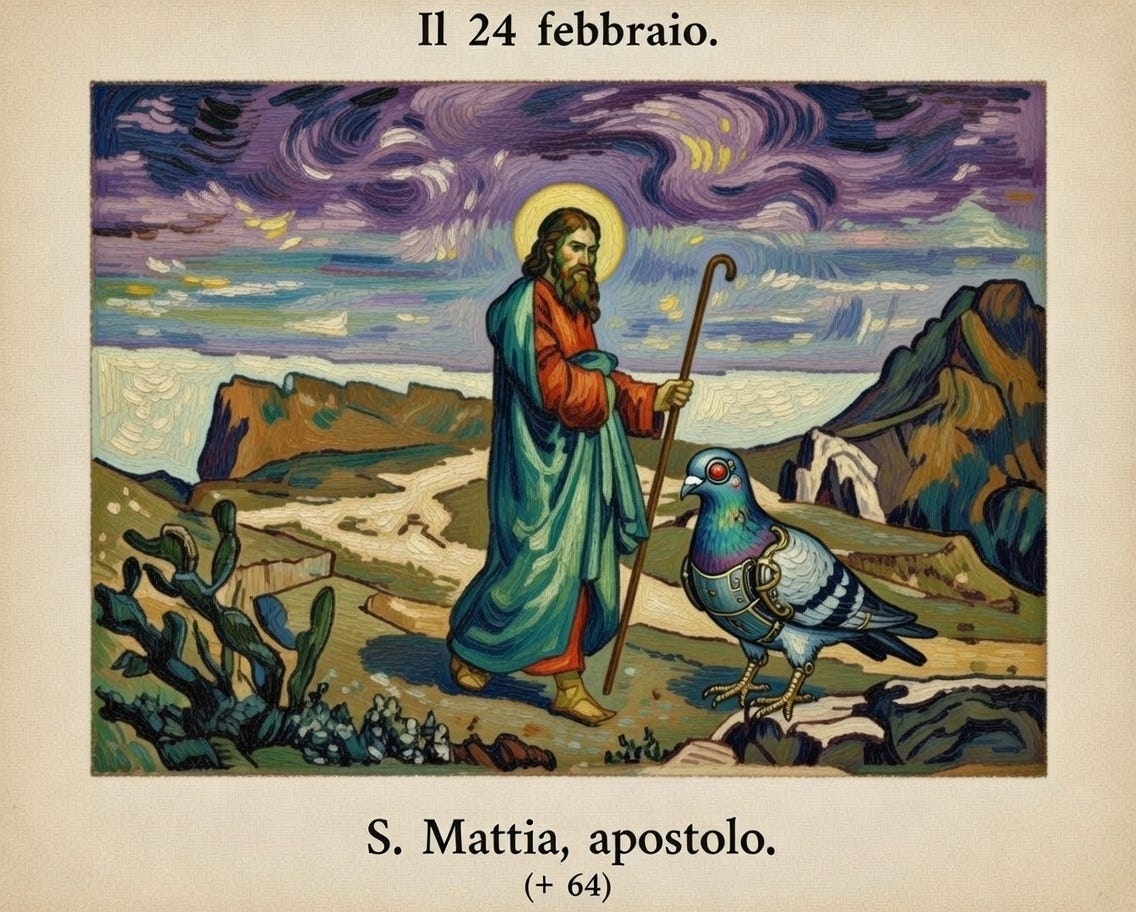
There are some people who were faithful. Who were witnesses in their time. Who were considered worthy of the title of Apostle: and we know very little. Matthias is one of these people. He was chosen by lot to replace Judas as one of the twelve, and that is all that is written about him in Scripture. We are otherwise relying on tradition, and the tradition varies widely. To get a biography and what few sayings survive took some searching — assisted here by Claude Keruru. The most plausible summary is that Matthias left Jerusalem at some point and went to the region of the Black Sea.
The only certain early information comes from the Acts of the Apostles (1:15–26). In the weeks between the Ascension and Pentecost, Peter proposed to an assembly of about one hundred and twenty disciples that the vacancy left by Judas Iscariot be filled. The requirement was strict: the candidate must have accompanied Jesus throughout his entire ministry, from the baptism by John through the Ascension, and must be a witness of the Resurrection. Two men met the criterion — Joseph called Barsabbas and Matthias — and after prayer, lots were cast. The lot fell to Matthias, who was numbered among the eleven. Acts says nothing more about him. He does not appear again in the canonical New Testament.
It is worth pausing on what the criterion does and does not tell us. The lot was cast precisely because human judgment was insufficient — as Proverbs 16:33 notes, the lot is cast but its every decision is from the Lord. The criterion in Acts 1:21–22 is evidentiary, not a verdict on superior character: Matthias had been present and was therefore a qualified witness. What we can say is that he had known Jesus throughout his public ministry, making him one of the original eyewitnesses — a standing that distinguished him from later claimants to apostolic authority such as Paul. Beyond that, the tradition varies. Nicephorus Callistus says he preached first in Judaea and then in “Aethiopia” — meaning Colchis on the eastern Black Sea, in modern Georgia. His death is equally contested: one tradition has him crucified, another stoned and beheaded (almost certainly two separate traditions merged), and Hippolytus of Rome implausibly says he died peacefully of old age in Jerusalem. The contradictions are characteristic of a figure about whom the community preserved almost nothing — and into that silence, competing traditions projected whatever each needed Matthias to have been. Matthias functions here as a type and an occasion rather than a historically documented exemplar, which is, if anything, more honest — and theologically sufficient.
My church does not follow the liturgical calendar, and the sermon that day had Paul discussing people preaching the gospel while using him as an example of what not to do — because he was in jail (Philippians 1:12–20). He did not care. He cared about Christ. The 1662 collect frames Matthias explicitly against Judas:
O Almighty God, who into the place of the traitor Judas didst choose thy faithful servant Matthias to be of the number of the twelve Apostles; Grant that thy Church, being alway preserved from false Apostles, may be ordered and guided by faithful and true pastors; through Jesus Christ our Lord. Amen.
The bluntness is notable — “the traitor Judas” is unusually direct for liturgical language. The petition is not primarily about Matthias at all: it is about the Church being preserved from false apostles and guided by faithful pastors. Matthias is the occasion, not the subject. That is fitting.
There are a small number of sayings attributed to Matthias, preserved by Clement of Alexandria in his Stromateis — though a word of caution is necessary. Clement quotes these fragments not to endorse a Gnostic reading but to contest one: he is arguing against the Carpocratians and other groups who had claimed the Matthias traditions as support for their positions. The sayings themselves were later classified as disputed or apocryphal by Eusebius, Jerome, and the Gelasian Decree. They are illustrative rather than authoritative. With that caution in place: Clement records that Matthias taught his hearers to fight against the flesh and never yield to pleasure, so that the soul might make progress in faith and knowledge (Stromateis 3.26.3); that a chosen one whose neighbour sins bears some responsibility, having failed to live in a way that drew the neighbour toward holiness (Stromateis 7.13.82); and that wonder at what is present is the beginning of knowledge (Stromateis 2.45.4–5).
Some would read the second saying — fight the flesh so the soul advances — as teaching a disembodied spiritual progress, the kind of thing that reappears in transhumanist language about uploading information as a substitute for the soul. The most prominent version of this is Ray Kurzweil’s “patternism”: the argument that personal identity consists of mental patterns — thoughts, memories, intentions — which can in principle be transferred to new substrates, just as software can be moved between machines (The Singularity Is Near, 2005). On this view, what you are is information; the body is merely current hardware. That reading of the Matthias fragment is worth resisting. It is not a new idea. Gnostic dualism said something structurally similar in the second century, which is precisely why those groups claimed the Matthias traditions for themselves. We are taught that we will be resurrected in our bodies, not that we will progress to some disembodied state. The better reading of the fragment is ascetic discipline in the service of embodied holiness: purity so that one can live like Christ, not escape from the body into pure mind. And the passage the lectionary gives us for this feast says it more clearly than any apocryphal fragment can.
Hebrews 4:14–5:10 (Revised Geneva Translation)
Seeing, then, that we have a great High Priest Who has entered into Heaven (Jesus, the Son of God), let us hold firmly to our confession. For we do not have a High Priest who cannot sympathize with the feeling of our infirmities; but was in all things tempted in the same way, yet without sin. Therefore, let us go boldly to the throne of grace, so that we may receive mercy and find grace to help in time of need.
For every High Priest is taken from among man (and is ordained for man, in things pertaining to God), so that he may offer both gifts and sacrifices for sins. He is able to have compassion on the ignorant and the wayward, because he also is encompassed by infirmity. And for the same reason he must also offer for his own sins as well as for the people’s. And no man takes this honor for himself, but rather he who is called by God (as was Aaron).
So likewise, Christ did not take this honor for Himself (to be made the High Priest), but He Who said to Him, “You are My Son. This day I begat You”. As He also, in another place states, “You are a priest forever, after the order of Melchizedek”, Who, in the days of his flesh, offered up prayers and supplications (with strong crying and tears) to Him Who was able to save him from death. And He was heard because he feared. And though He was the Son, he still learned obedience by the things which he suffered. And being consecrated, He was made the Author of eternal salvation to all who obey Him.
This is the answer to disembodiment. The Son took a real body, suffered in it, and was perfected through suffering — so that He can sympathize with ours. The Incarnation is the permanent refutation of any theology that treats the body as mere scaffolding to be discarded on the way to something purer.
We know little about Matthias, but we know more about Christ and the twelve He chose. None of them were credentialled in the ways the world recognises. The person who had the formal qualifications was Saul — trained by Gamaliel, an acknowledged rabbi, an activist for the Sanhedrin — and he was converted and sent to the Gentiles. The Twelve were mostly Galileans, described in Acts 4:13 as unlearned men. They were not prosperous, though they were supported from early on by some merchants and members of the ruling class. As Peter said, they gave up everything to follow Jesus. Tradition holds that most of them died violently for it — from scripture we know some did; tradition extends this to all but John.
The point is not that credentials are worthless — God has always used prepared people, and the apostles’ three years with Jesus were themselves the most intensive formation imaginable. The point is that credentials were not their goal. The Roman cursus honorum — officer in a legion, then magistrate, then general, then senator, then consul at the prescribed age — was the credentialling system of their world. That system fell apart. Ours will too. The trap is not competence or learning. The trap is making the prize the goal.
As Vox Day observes (Sigma Game, Substack, February 2026):
If your goal is the prize, the publication, the tenure, or the invitation to the right conference, then your relationship to your own work is permanently mediated by other people’s opinions of it. You never know whether your work is any good. You only know whether the guild says it’s good. And since you know, at some level, that the guild’s approval process is not a truth-tracking mechanism but a social one, you can never fully trust the approval you receive, no matter how much of it you get. The syndrome isn’t a malfunction. It’s an accurate perception of the situation: you genuinely don’t know whether you deserve your accolades, because the recognition was never about whether the work was right. It only concerned whether the work was acceptable to the in-crowd or not. Someone who is working to discover what is true doesn’t have that problem. Either the amphiboly is there or it isn’t. Either the fixation math works or it doesn’t. Either the twelve historical cases confirm the empirical predictions or they don’t. The work provides its own verdict.
Matthias is one of those who was faithful. He remained with Christ from the beginning. He knew that the goal was not the honour of the world but to glorify God. He points not to legalism, nor to prosperity, but to Christ — who suffered for us, and died for us, and is the Priest who is King of all and salvation to all. Too many people in our society cannot see that goal. They have been deceived by ephemeral prizes. That is a trap we need to turn away from.
A note on method: this essay was researched and drafted using a version of the Triveritas stress-test workflow described in the previous post on this blog. Grok provided the adversarial structural critique (Leg 1); Claude Keruru handled research, drafting, and synthesis. The process caught factual errors, a source inconsistency in the Clement section, and other things single-model review misses. The cybernetic kererū in the image above is a small marker of the same point: a native New Zealand bird introduced into a nineteenth-century Italian devotional engraving, acknowledging that the apostolic witness reaches here too, to this place the original engraver could not have imagined. The tools are not the problem. Making the tools — or the recognition they bring — into the goal is the problem.