
Thomas Chalmers, 1847
31 May

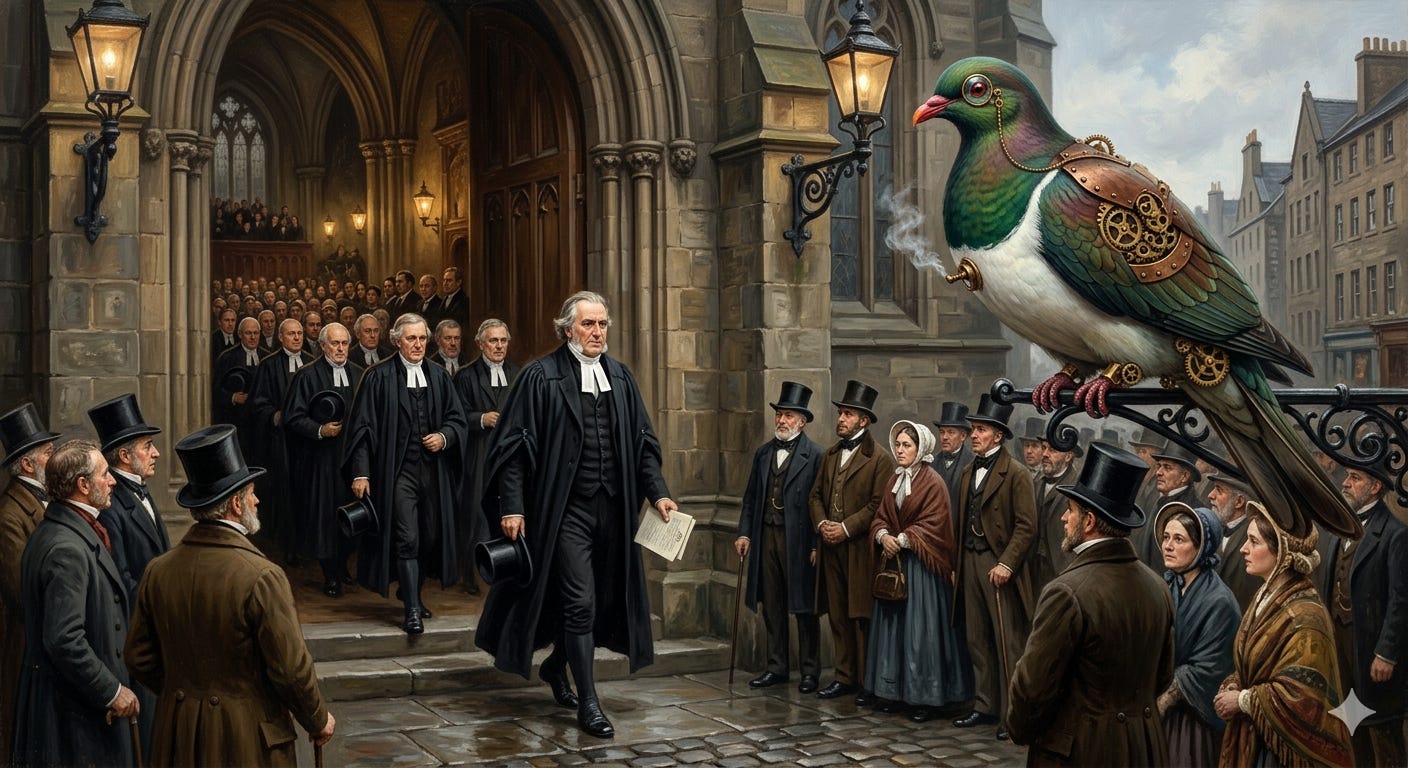
Then the eleven disciples went into Galilee, and to a mountain where Jesus had directed them. And when they saw Him, they worshipped Him. But some doubted. And Jesus came and spoke to them, saying, “All power is given to Me, in Heaven and on Earth. Go, therefore, and disciple all nations, baptizing them in the Name of the Father, and the Son, and the Holy Ghost, teaching them to observe all things, whatever I have Commanded you. And lo, I am with you always, until the end of the age. Amen.” — Matthew 28:16–20
He died inside the work.
On the Friday he had come home to Morningside from London, where he had gone to argue the case for national education. On the Saturday he sat preparing a report for the General Assembly of his church, then sitting in Edinburgh. On the Sunday he kept the day in his usual health and good spirits and went to bed meaning to rise early and finish the report. On the Monday morning he did not come down. They found him in his bed, the paper unfinished on the desk, and the church he had built four years before went on without him.
It is the right way to begin, because it is the whole of him in one image. Thomas Chalmers reached his own end of the age with the report unfinished, and the commission he had spent his life serving simply continued. Lo, I am with you always. The promise is not that the worker endures. It is that the work does.
We are apt to remember him in pieces. The mathematician’s son from Anstruther who went up to St Andrews at eleven and never quite stopped lecturing on conic sections even after his ordination. The country minister of Kilmany who read Wilberforce’s Practical View in his illness and came out of it an evangelical, preaching now not duty but a Saviour. The pulpit phenomenon of the Tron, of whom Wilberforce’s own son wrote that “all the world is wild about Dr Chalmers.” The man whose Astronomical Discourses — sermons on whether the gospel could matter in so vast a universe — sold twenty thousand copies in a year, when twenty thousand was the population of a town. We remember the political economist who answered Adam Smith on Smith’s own ground, refusing to let the cure of souls be left to supply and demand; who wrote that character is the parent of comfort and not the reverse, and meant it as a rebuke to every scheme that would feed a man’s body while starving the thing that makes him a man.
And we remember St John’s. In 1819 he took the largest and poorest parish in Glasgow — two thousand families, of whom eight hundred belonged to no church at all — and he did not wait for the city or the state to act. He divided the parish into twenty-five districts, set an elder or a deacon over each, built schools, opened Sabbath classes for a thousand children, and took the relief of the poor out of the impersonal hand of the rate and into the hand of the neighbour. By his own books the pauper roll, which had cost the parish fourteen hundred pounds a year, fell within four years to two hundred and eighty. His critics said, rightly enough, that it could not be done at scale by ordinary men, that it worked because Chalmers was extraordinary — and the later archives bear them out: the figure counted his deacons’ fund and not the whole burden of the poor, and the scheme leaned on a personal vigilance no successor could supply. They were right about the experiment and wrong about what it was for. He was not building a system to be admired or copied house for house. He was running an experiment, and he was keeping the books, so that when the day came that he needed a whole church to fund itself without the state, he would already know how the principle worked — not the genius, which died with him, but the method, which did not.
That day came in 1843. But to see why it came we have to understand the one thing about Chalmers that the encyclopaedias get wrong.
They like to say he cared more for human problems than for doctrine — the practical philanthropist who happened to wear the collar. It is a half-truth that becomes a lie. Hear him in his own words, spoken to the royal commissioners at St Andrews before either of the great controversies had broken: I have no veneration for the Church of Scotland qua an establishment, but I have the utmost veneration for it qua an instrument of Christian good. And again, near the end of his life, with the Free Church standing around him as his monument: Who cares about the Free Church, compared with the Christian good of the people of Scotland? Who cares for any Church, but as an instrument of Christian good?
There is the man entire. His loyalty was never to the establishment. It was to the commission the establishment existed to serve. This is why he could spend the 1830s defending the principle of a national, endowed church against the Voluntaries — who would have the state fund no church at all — and then, in 1843, walk out of that very establishment. He had changed; it is honester to say so than to pretend he never wavered. The younger Chalmers prized establishment as a good in itself, the standing duty of a Christian nation, and fought for it as such. What did not change was the thing beneath it. A national church is good as a means of discipling the nation; the establishment is one arrangement for that end, to be held while it serves and surrendered when it does not. That is not a man fooling himself into a contradiction. It is a man who loved a good means and was forced by a deeper love to give it up — and only if you mistake the means for the end does the leaving look like incoherence. When the state offered to keep the church established on condition that the civil courts might govern its spiritual acts — might tell a congregation which minister it must receive, against its will and against the church’s own courts — then the establishment had stopped being an instrument of Christian good and had become an instrument of the state. So he left, and he took the commission with him out the door.
What kept that order from being mere pragmatism — a man calling whatever he wished to do “the Christian good” — is that the order was given to him and not chosen by him. The Law ranks our loves. Thou shalt love the Lord thy God with all thy heart, and with all thy soul, and with all thy mind, and with all thy strength: that is first, and it is total, the love that admits no rival and keeps back no remainder. Thou shalt love thy neighbour as thyself: that is second, and it sets the neighbour’s worth level with one’s own, to be loved without diminution. And the new commandment lays over the household of faith a love measured by Christ’s own — as I have loved you — the self-giving depth, and with it the first claim of covenant duty: to do good unto all men, but especially unto them who are of the household of faith. The nation is none of these in itself. It is the community written large, and it is served through these loves, built upward from them, never set above them. So the loves stand ranked: God without remainder, then His Church loved as Christ loved her, then the neighbour as oneself, and the nation as the good of the whole, resting on all three. A ranked love is not an elastic one. When two goods cannot both be kept, the lower yields to the higher, and the point at which it yields is fixed.
That fixed point is the thing the encyclopaedias and the critics alike walk past. Establishment is a good of the third order — a real good, a good of nation and of community, worth defending, and Chalmers defended it for thirty years. The spiritual independence of the Church — Christ’s sole headship over the house He built — is a good of the first order, the love of God with all the mind, which will not suffer Caesar to govern the worship and the discipline that Christ instituted. For decades the two stood together and he held both with a whole heart. In 1843 the Court of Session forced them into collision and made him choose: keep the establishment, and let the civil power define the Church’s spiritual acts; or keep the headship, and lose the establishment. There is no flexion in what he did, and no elasticity in the rule that governed it. The lower good yielded to the higher because that is the order of love, and the order does not bend to suit the man. One who had opposed establishment from the start, or who stayed in and let the state rule Christ’s house, would each have broken the order — the first sacrificing a real good for no higher one, the second subordinating the first love to the third. Chalmers alone kept the ranking, in 1830 and in 1843 both, and it is only because the ranking never moved that the life holds together.
This is the deepest sense in which we read the whole story by the eighteenth verse of Matthew. The Court of Session held that the church possessed its functions on condition of such obedience as the civil power required. The Claim of Right answered that all power in heaven and on earth had been given to Christ, and to Christ alone, over His own house. The answer turns on a premise the Scots had held since Andrew Melville told James the Sixth to his face that there were two kingdoms and two kings, and that in Christ’s kingdom the King of Scots was “not a king, nor a lord, nor a head, but a member”: that Christ did not merely reign over the Church but instituted it, with a government of its own — the power of the keys, to bind and to loose, to ordain and to discipline — which He committed to His Church and never to the magistrate. “All power is given to Me” is not, by itself, the boundary. The boundary is that the One who holds all power gave the keys to the apostles and not to Caesar. The magistrate is nurse and guardian of the Church; he may not preach, baptise, ordain, or excommunicate, and he may not instruct the Church’s courts whom to ordain or whom a congregation must receive. That is precisely what the Court of Session had presumed to do. The crown of Scotland sat under the Crown of the Redeemer and not beside it. There is no compromise available between those two sentences. One of them says the magistrate is supreme over the spiritual sphere; the other says Christ is. Chalmers chose. On the morning of the eighteenth of May two hundred and three commissioners rose in the Assembly and walked out, down through the Edinburgh crowds to Tanfield; and in the days that followed some four hundred and seventy ministers — a third of the clergy of the national church — abandoned their livings, four hundred and fifty-one of them signing the Deed of Demission that gave away manse and stipend and parish church and all worldly security, for a clause of the Great Commission. The Sustentation Fund that caught them when they fell had been waiting, in embryo, in the parish books of St John’s for twenty years. He did not wait. He had already built it.
The reader who came here by way of an earlier essay will see what stands behind 1843. Ten years before the Disruption, in the summer of 1833, John Keble climbed into the pulpit of the University Church at Oxford and preached on national apostasy — against a Parliament that had presumed to suppress bishoprics by Act, the post-Reform state reordering the church of Christ by statute. The same provocation that lit the Ten Years’ Conflict in the north lit the Oxford Movement in the south, in the same decade, out of the same liberal and Erastian conditions. Two churches felt the same hand of the state at their throat, and answered in opposite registers. The Tractarians reached backward and upward, to apostolic succession and the undivided Church, grounding the deposit in an authority older than any Parliament — and that logic, followed honestly, carried Newman to Rome. The men of the Disruption reached up to the Headship of Christ and down to the right of a congregation, bypassing crown and mitre alike. Episcopal catholicity against presbyterian crown-rights; the scholar’s long retreat into the Fathers against the builder’s walk into the structure he had already raised. But the temperaments followed from the theologies; they did not stand in their place. A church that locates its authority in an unbroken succession will turn backward to recover it; a church that locates authority in Christ’s living grant to its own courts will turn its hand to the present work. Apostolic succession and intrinsic jurisdiction are not two pieties but two methods — two frameworks for keeping the law above the king and the first love first. The end they serve is one. It is the way to it that divides them, and where each way finally leads is the burden of the essays to come. It is the same wound and two surgeries, and I mean to follow the Oxford men through their own door in the months to come. For now it is enough to say that Chalmers stands between the essay behind and the essays ahead, and that he won his argument not because he was the better theologian — he was not — but because he had done the work that let him act on the day the ruling came.
Set the two men side by side and the deeper agreement shows through the difference. Both had seen the same thing and feared it for the same reason: an established church that cannot confront the throne is worse than no establishment at all, because it leaves the throne with nothing above it. The Mosaic law had legislated against exactly this. The one statute Israel was given for her kings does not tell the king to make the law — it tells him to copy it: to write himself, in a book, a copy of the law from the volume the priests keep, and to read in it all the days of his life, “that his heart be not lifted up above his brethren.” The king does not author the law. He transcribes a text he does not own, held in a sphere he does not control, and his daily submission to it is the named safeguard against his becoming a tyrant. Take the pen out of the priests’ keeping and the king stops copying and starts writing — and the king who writes the law is Pharaoh, is Saul taking and taking, is the Court of Session redrawing the jurisdiction of Christ’s Kirk. Keble located the unowned text in apostolic succession; Chalmers in the intrinsic jurisdiction of the Kirk; both were defending one constitutional fact, that there is a law above the magistrate, kept by a sphere the magistrate may not absorb. And mark the limit, for it cuts both ways: the priest who keeps the text does not wield the sword. The Church confronts the king as Ambrose confronted Theodosius — barring him from the altar until he repented, never reaching for his crown. Sphere sovereignty forbids the magistrate to swallow the Church; it forbids the Church to swallow the magistrate. The thing Chalmers fought was never that the king ignored the Church. It was that the king would no longer copy the law.
Then the nineteenth verse: disciple all nations. The grammar will not quite bear the whole weight some of us want to load on it — the command is to make disciples from among the nations, person by baptised person, and an honest reader grants it before pressing on. But Chalmers did not get his national church from a Greek plural. He got it from the covenant: from a Scripture that treats a nation as a moral person before God, that summons a people called by His name to humble itself and turn and be healed, that legislates for a king and a land and not for private souls alone. “Teaching them to observe all things whatsoever I commanded” is a charge with no edges — it does not halt at the church door — and a nation living under that teaching is a godly commonwealth. The vision scales both downward and out. Downward, it is the parish that will not abandon eleven thousand souls in a Glasgow slum to the market. Outward — and here is the thing that should make a Calvinist at the bottom of the world set down his coffee — it is a city.
For the Free Church did not only rebuild in Scotland. Within a year of the Disruption its people were planning a colony at the far edge of the earth, and in the November after Chalmers died the first emigrant ships stood out from Gravesend and Greenock, bound for the southern coast of a country Cook had charted within living memory. They might have called the place New Edinburgh, and set the English name aside for the older one: they called their town Dunedin — Dùn Èideann, the Gaelic of Edinburgh, a New Edinburgh under its first name. And the harbour by which you reach that city they named Port Chalmers, for the man himself. He had died in the May. He did not live to see the ships sail that November, nor make the harbour the autumn after. The commission ran clean past his grave to the ends of the earth, to a green harbour in the South Pacific that still carries his name on the charts — and those of us who read and write and worship on this discipled ground, who do our work at the university his people planted and watch the same magistrate reaching once more for the same throat, are standing inside Thomas Chalmers’s Great Commission whether we knew it or not.
Which returns us to the unfinished report on the desk in Morningside, and to the last clause: and lo, I am with you always, until the end of the age. He had asked the only question that mattered to him — who cares for any Church, but as an instrument of Christian good? — and he had answered it with his life, which is the only honest place to answer it. The answer to how you rebuild a church the state has captured is not rebuild after the rupture. It is build, before the rupture, while you still have slack, the thing that will go on standing when you do not. Build the fund before you need it. Keep the books at St John’s twenty years early. Found the college within months. Send the ships. Then die in your bed with the report unfinished, and trust the promise that the work does not depend on the worker.
He was Scotland’s greatest churchman, and he was buried in the Grange — the first grave in that ground, a great crowd of every denomination walking behind. The report was finished by other hands. The Assembly went on. The ships sailed. Lo, I am with you always.
Amen.