
Pusey’s Glorious Failure

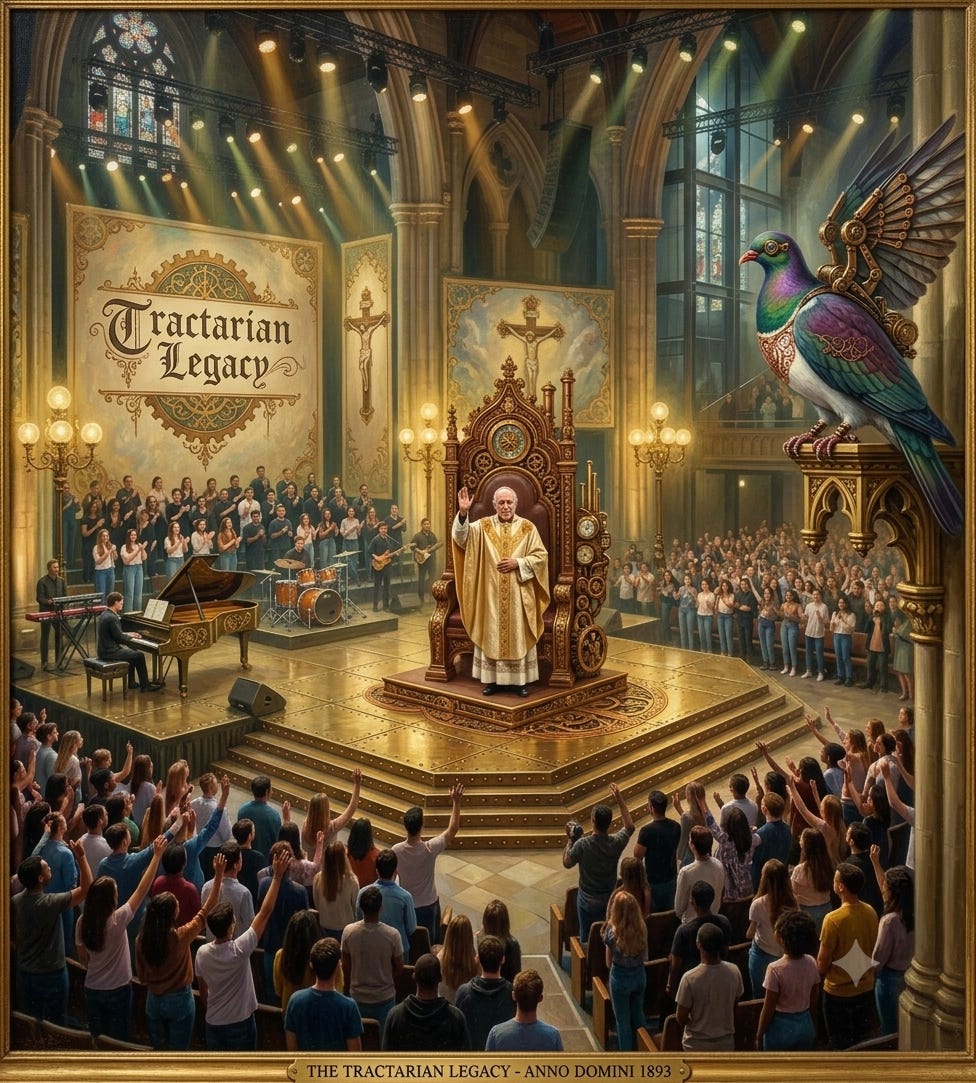
I was thinking about the Tractarians of the 1830s, whom I noted last week were facing the same crisis that had been convulsing the Presbyterian Church of Scotland. Both churches were established: the state existed to protect them, and the Two Kingdoms doctrine — the king is king of the commonwealth but a member of the kingdom of God, not its head — had been the operating assumption for two centuries. That assumption was now being challenged. The state was no longer merely neutral. It was claiming the right to interfere in the internal workings of the church.
In Scotland this produced a legal battle that lasted ten years and ended in the Disruption of 1843 — two hundred and three commissioners walking out of the General Assembly on 18 May, surrendering their manses and their stipends, with nearly four hundred and seventy-four ministers ultimately leaving their livings to found the Free Church of Scotland. In England it produced something quieter but in its own way just as remarkable: a group of Oxford clergy writing anonymous tracts.
Until Pusey signed one.
The World That Made the Crisis
The 1820s in Britain were not merely difficult. They were a decade in which the assumptions of English social life were being dismantled faster than anyone could name what was being lost.
England, Russia, and Austria had won the Napoleonic Wars, but victory in 1815 did not bring prosperity. It brought three hundred thousand soldiers and sailors discharged into an economy that could not absorb them — many crippled, all of them suddenly without income or purpose. The Corn Laws of the same year, passed by a Parliament of landowners to protect their own grain prices, kept bread expensive for people who were already hungry. When Britain returned to the gold standard in 1821, the deflationary pressure fell hardest on those who could least carry it. David Ricardo said this was necessary. His models were elegant on paper. They translated into poverty in real life.
Then came the Catholic Emancipation Act of 1829. Protestant Dissenters had already been partially freed in 1828. Now Catholics could sit in Parliament. The High Tory consensus that had held since the Glorious Revolution fractured. The established church, which had been the assumption beneath every assumption, was now one institution among others — still privileged, but no longer coextensive with English civic identity.
These were not merely political events. They were the dissolution of a way of life that had been stable, in its imperfect and often unjust way, since the fourteenth century. The Anglican rural parish — the liturgical seasons marking the agricultural year, the parson as the educated man in the village, the church as the place where you were baptised and married and buried and knew the names of the dead on the walls — had worked. It had held a civilisation together through plague and civil war and revolution next door. It was not working now. The economic pressures of industrialisation and the political pressures of emancipation were together pulling the village apart, sending its people to Manchester and Leeds and Birmingham, into conditions that the Book of Common Prayer had never anticipated and the rural parson could not follow.
The village was dying. And with it, the church that had been woven into the village’s life for five hundred years.
The Two Kingdoms and the Tracts
Into this crisis, in 1833, came the Tracts for the Times.
The immediate occasion was specific: the Whig government had suppressed ten Irish bishoprics by act of Parliament. To John Keble, preaching the Assize Sermon at Oxford on 14 July 1833, this was not merely a political inconvenience. It was apostasy — the state claiming authority over the church that the church could not concede without ceasing to be the church. The Two Kingdoms principle was the same issue the Scottish church had been fighting for in the courts for a decade. The king is king of the commonwealth; he is a member of the kingdom of God, not its head. The state may protect the church. It may not govern it.
This was, in one sense, the founding legal document of the Church of England turned against itself. The Thirty-Nine Articles had placed the Crown as the head of the church in England. For three centuries this had been manageable because the Crown and the establishment were effectively identical — the same class of people, the same interests, the same assumptions about what England was and who ran it. When the Whigs moved to suppress Irish bishoprics on grounds of efficiency and administrative rationalisation, they were operating from within precisely those assumptions. The church was a department of state. Departments of state could be reorganised.
Keble said: no. Newman said: no. And they began to write.
The tracts were short, pointed, cheap, and widely distributed. They were addressed to the clergy of the Church of England — educated men who could feel the ground shifting beneath them but had not yet found language for what was happening. The format was deliberate: not a learned theological treatise, not a parliamentary petition, but something more like a broadsheet — a direct appeal to men in their studies and their vestries, asking them to consider what the church actually was and what it owed to its own inheritance.
The first tracts came out anonymously. Newman wrote most of them. Keble wrote his. Others contributed. The anonymity was partly caution, partly a recognition that the argument mattered more than the author.
The Man
Edward Bouverie Pusey was born of noble parents on 22 August 1800, and imbibed Catholic principles at his mother’s knee. A weakly, delicate boy, quiet and retiring, fonder of books than of games, he always wished to become a clergyman. At Oriel College, Oxford, he met John Keble and John Henry Newman. With remarkable prescience of troublous days in store, he began with indefatigable industry to fit himself to stand, and help others to stand, against the coming tide.
He learnt German. He learnt Arabic, Syriac, and Chaldee, often working sixteen hours a day with frail health. By 1827 he was the most learned scholar in England. He was appointed Regius Professor of Hebrew at Oxford, a post he would hold for fifty-four years. He had been awakened to the danger by a long and fruitless correspondence with a young atheist. As he said in later years: “I suppose I have read more infidel books than anyone living. I have read them until I flung them to the ground, sick with horror and loathing.” That fruitless effort was a blessing in disguise. It gave him his first real experience of the deadliness of rationalist thought applied to faith. “It decided me,” he said, “to devote my life to the Old Testament; as I saw that was the point of attack in our defences which would be most easily breached.”
He foresaw the German higher criticism before it arrived in England. He prepared. He read. He built.
A very human Pusey was hidden beneath the sober scholar. As a young man of eighteen he had met Maria Raymond Barker, daughter of a Shropshire family. He fell in love immediately. Their parents intervened. For ten years they were separated. Pusey suffered a permanent and deep depression; his health was seriously impaired. Maria did not marry. She had given her heart and would not withdraw. Ten years passed and they met again and married. Their married life, by all accounts, was beautiful. They entertained and read together and prayed together. Then she died, and he faced a future of lonely service. Newman, who cared so deeply for Pusey that he could not bear to tell him plainly he was dying as an Anglican, came to see him on the morning of her death. Newman was the only friend Pusey would see. For many months he was inconsolable.
He went back to work. He always went back to work.
In December 1833, Pusey published Tract 18: On the Benefits of the System of Fasting Enjoined by Our Church. The previous tracts had been anonymous. This one carried his initials. It was the first tract so signed, and it changed everything — not because of what it said about fasting, but because a named Oxford don of European scholarly reputation had publicly associated himself with the movement. The movement became Puseyism. His name became a term of insult.
The insult is diagnostic. Nobody really cared about the fasting. What the broad Anglican majority found threatening was what the fasting implied: that the faith makes actual demands on the body, that Christian practice is not merely interior and sentimental, that there are disciplines which cost something. The broad church settlement was comfortable precisely because it asked nothing uncomfortable. Pusey’s argument was not a polemic against that comfort — it was something more dangerous. It was a demonstration, by example, of what the alternative looked like.
His theology was deeply patristic and catholic, which was nothing new in Anglicanism. Henry VIII himself had believed in the Real Presence of Christ in the Eucharist — body and blood at the altar, not symbol, not memorial, but the thing itself. Pusey believed the same. He argued it from the Fathers of the early church, building a scholarly case that the Anglican formularies, imprecise as they were, had never actually abandoned this doctrine. The Book of Common Prayer had not resolved the question. It had held it open. Pusey wanted to hold it open in the direction of the ancient church rather than in the direction of Protestant minimalism.
His argument about fasting, in Tract 18, captures the whole of his project in miniature:
The practical system of the Church is altogether at variance with that which even pious Christians in these days have permitted themselves to adopt; much which she has recommended or enjoined would now be looked upon as formalism, or outward service: in our just fear of a lifeless formalism, we have forgotten that every Christian feeling must have its appropriate vehicle of expression; that the most exalted acts of Christian devotion, that our closest union with our Saviour, is dependant upon certain forms; that the existence of forms does not constitute formalism; that where the Spirit of Christ is, there the existence of forms serves only to give regularity to the expression, to chasten what there might yet remain of too individual feeling, to consolidate the yet divided members “in the unity of the faith, and of the knowledge of the Son of God, unto a perfect man, unto the measure of the stature of the fulness of Christ.”
This is not a defence of ritual for its own sake. It is an argument that the inner life requires a body to live in, that devotion requires a form to travel through, that the Spirit does not float free of practice but inhabits it. The body fasts. The body kneels. The body receives the sacrament. These are not optional decorations on a faith that could exist without them. They are the vehicles through which the faith becomes real in a person, over time, through repetition and discipline and cost.
In 1843, Pusey preached a university sermon on the Holy Eucharist. He was suspended from preaching for two years. The sermon had said nothing he had not argued from the Fathers, nothing the Prayer Book had actually contradicted. But the broad church was finished with him. The insult deepened. He bore it and kept working.
The Failure of the Assumptions
Pusey was doing the right work in the wrong institution, and the wrong institution was wrong in ways that were not fixable from inside.
The Church of England had been founded on a set of assumptions that the 1820s were systematically destroying. The first assumption was that England was a Christian nation in a meaningful sense — that the church and the commonwealth were coextensive, that being English and being Anglican were effectively the same thing. The Corn Laws breaking the village, the factory towns with no parish structure, the Catholic Emancipation Act opening civic life to those outside the establishment — all of this was dismantling that assumption without anyone replacing it with anything.
The second assumption was the royal supremacy: the Crown as the earthly head of the church. This had always been theologically awkward. The Two Kingdoms doctrine, which both Keble and the Scottish church understood with perfect clarity, made it incoherent. You cannot simultaneously claim the undivided patristic church as your authority and have Henry VIII as your ecclesiological reference point. Newman saw this and left. He went to the one institution that could plausibly claim authority above the Crown rather than under it. His logic was impeccable.
Pusey saw it and stayed. This was not intellectual failure. It was a different kind of faithfulness — to the Church of England as the legitimate expression of the Western church in England, flawed and legally compromised but still the church of the English people, still carrying the sacraments, still ordaining priests in apostolic succession, still holding the Book of Common Prayer which was, whatever its ambiguities, one of the great achievements of Christian liturgical writing in any language.
He was not wrong that these things were worth defending. He was wrong that the institution could be saved from within, on his terms, by retrieval of the patristic foundations. The foundations were real. The building had been built on different ground.
The failure was structural before it was personal.
What Filled the Gap
When the rural parish died, something had to fill its place. Several things did.
In Scotland, the Free Church took the energy that Disruption had generated and turned it outward. The low church tradition, the evangelical wing of Anglicanism, and eventually the Methodists — all carried the faith into the industrial towns that the established church had not followed its people into. The Church Army and the slum priests of the late Victorian era did work that the broad rural parson had never been asked to do, in conditions he would not have recognised. William Booth built the Salvation Army on the premise that the Church of England had abandoned the urban poor, and he was largely right.
These were not Puseyite movements. They were low church, often charismatic in practice if not in name, oriented toward conversion and social reform rather than sacramental continuity and patristic recovery. They disagreed with almost everything Pusey had argued for. But they were alive in a way that the broad church settlement, which Pusey had diagnosed as dead, demonstrably was not.
The social gospel followed. The institutional churches of the late nineteenth and early twentieth century poured their energy into social reform — housing, wages, education, the welfare of the poor. This was not ignoble. Much of it was necessary. But it contained within itself the seeds of its own dissolution: once the church’s purpose was defined primarily in terms of social outcomes, the question inevitably arose why the church was necessary to achieve them. The state could run hospitals. The state could fund schools. The state could build housing. What did the church add, except a doctrinal superstructure that the broad church had been systematically dismantling for a century?
By 1930 the broad rural parson was dead. By 1960 the social gospel was in its death throes. By 2000 the Church of England was managing decline with the resources of an institution that had once been coextensive with England and was now a minority denomination with a large property portfolio and a shrinking congregation.
Pusey had seen this coming in 1833. He had spent fifty years trying to prevent it by a different route. He failed. The institution he defended is, in any meaningful sense, gone — not legally extinct, but theologically emptied, institutionally captured by the broad church latitudinarianism he had diagnosed as entropy, not stability.
Keble tried a different instrument. He wrote poetry. The Christian Year, published in 1827, was one of the most widely read books of the Victorian era — a collection of poems keyed to the liturgical calendar, making the cycle of the church’s year present to the imagination of ordinary readers who might never hear a Tractarian sermon. It was formation by beauty rather than argument. It worked, within its limits, in the way that formation by beauty always works: slowly, indirectly, in the life of individuals rather than in the transformation of institutions.
The poetry outlasted the movement. The movement did not save the church.
The Glorious Failure
Pusey was glorious and a failure. The glory and the failure are the same thing.
He was right about what was being lost. He was right that the patristic structure was the real architecture of the faith and that the broad church settlement was entropy, not stability. He was right that sacramental realism was not optional decoration but constitutive of Christianity’s claim on the body and the world. He was right that the forms of devotion were not formalism but vehicles — necessary, costly, worth defending.
And he staked everything on an institution whose founding assumptions had already collapsed by the time he signed his first tract. The royal supremacy was not a fixable bug. It was the architecture. The coextensiveness of church and nation was not temporarily declining. It was structurally gone. He spent fifty years as Regius Professor retrieving patristic foundations for a building whose site had been resumed.
The tragedy is not that he failed. The tragedy is that the thing he was trying to save was genuinely worth saving and the conditions for saving it were not available to him.
This is the situation of every serious Christian intellectual operating inside a dying establishment. Cranmer had it. Pusey had it. The mainline Presbyterian liberals who drove out the Westminster Confession people in New Zealand and Scotland and across the Anglophone world in the twentieth century accidentally recreated it from the other side — defending an institutional form whose animating assumptions had quietly departed.
The confessional community that does not depend on establishment assumptions is the only form that survives. The Scottish Covenanters understood this. The Westminster Assembly encoded it. The congregation that recites the Heidelberg Catechism in 2026 — not as heritage but as formation, not as nostalgia but as the actual content of the faith — demonstrates it weekly.
Pusey was magnificent and he was building on sand he had mistaken for rock. The rock was there. It just was not under the Church of England.
What Is Coming Back
But here is the thing Pusey could not have known from inside 1833.
The streams that left when the broad church emptied are returning. Not into the institutional forms — those remain largely hollow. But the hunger for what those forms once carried is real and growing.
Mary Harrington delivered an address at Pusey House, Oxford, in March 2026 — in the building named after the man, one hundred and forty-three years after his first signed tract. The conference was titled Christian Revival: Our Post-Liberal Hope? She was not speaking as an Anglo-Catholic or as a defender of Tractarian theology. She was speaking as a cultural analyst who had been watching what happens to people when the digital age strips away the last residues of the modern secular settlement. What she described was this:
Many people sense the great weirding, and in many cases – notably the young and very online – decide that the best way to make sense of what’s going on is not reinventing the wheel. In some cases I know personally, people have had encounters with internet phenomena so uncanny they concluded that it’s best to take refuge in a community where people will take you seriously and offer to help, if you say you feel haunted. Speaking personally, I can attest that the only reliable remedy I’ve found yet for internet poisoning really is prayer. If you know you know.
Lest you think this is a tepid, relativistic “cultural Christianity” namecheck, let me clarify. For those keen to find a footing amid re-enchantment, without reinventing the wheel, Christianity has the great advantage of being true. But inasmuch as there’s been discussion of a “quiet revival” all indications are that, if it is happening, this is less within the Christian mainstream than what were previously the edges: “high” and “low” churches, liturgical or charismatic. In other words, people seek either the sense of mystery that comes with ritual, structure, and continuity with the past, or else the fulness of emotion and connection attendant on praise and worship in the charismatic style.
High and low. Liturgical or charismatic. The two streams that left when the broad middle emptied — Pusey’s stream and the stream of the slum priests and the Methodists and the free church evangelicals who disagreed with almost everything he argued — are the streams now returning.
What they have in common is that neither of them is content with Christianity as a social function or a cultural memory. Both of them insist that the faith is true, that it makes actual demands, that it costs something. Pusey said that in 1833 about fasting. He said it about the Real Presence. He said it about the patristic authority of the church against the claims of the state. He was mocked for it. His name became an insult. He kept working.
The broad church is dying for the second time. The edges are returning.
Pusey was not wrong. He was early. The institution he defended did not survive. What he defended in it is coming back.
Sources: Tract 18 — On the Benefits of the System of Fasting Enjoined by Our Church (Wikisource). Mary Harrington, Not the Re-Enchantment We Ordered, address at Pusey House, Oxford, 11 March 2026.
Cosigned by your favorite nutjob charismatic. This is EXACTLY what I require - a faith in God, Who is supernatural, not a faith in Being Really Quite Nice.