
Dunstan 988
19 May

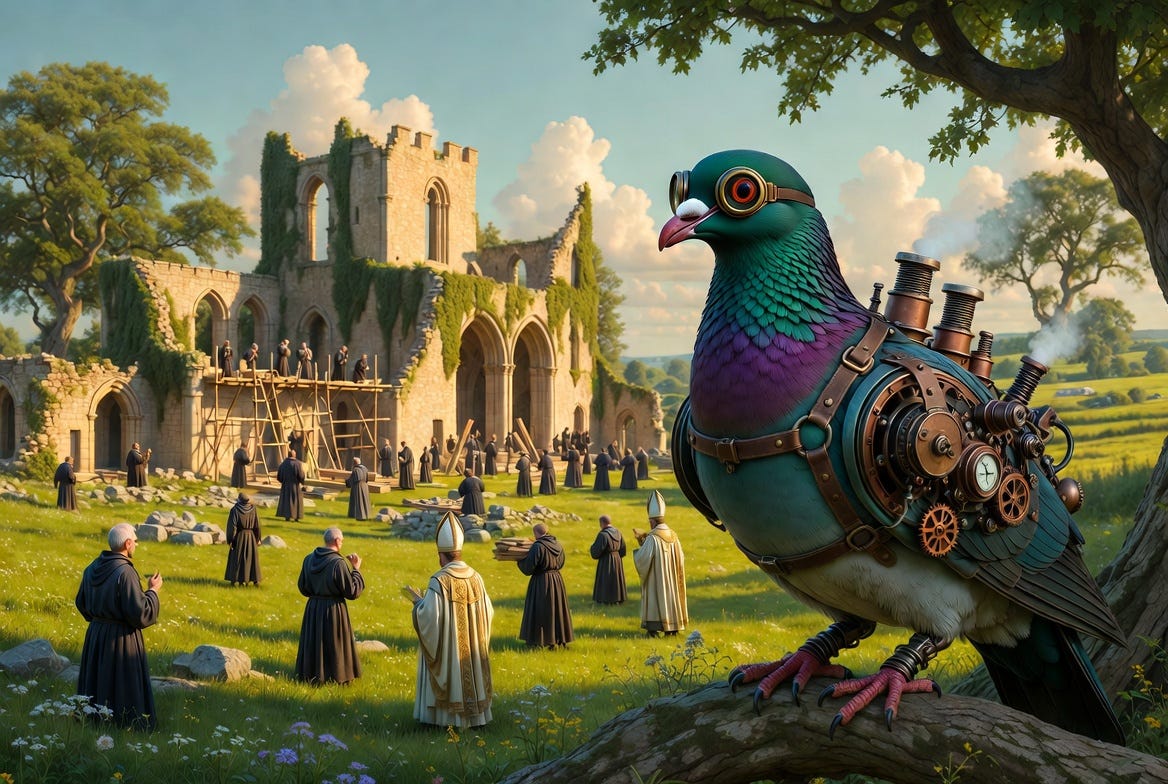
There are periods in the life of nations when almost the whole of the institutional architecture of learned culture is lost. Books are burnt or simply rot in the libraries of monasteries that no longer have monks. The schools close because there is nobody left who remembers what was taught in them. The arts of building and metalwork and music persist only as half-remembered fragments practiced by craftsmen who can no longer name the masters they descend from. The grammar of the old learned language goes first, because it was always artificial and required deliberate transmission; the literature of that language goes next, because nobody can read it; the theology and law and philosophy that were carried in that literature go last, because they were the substance of the culture and their loss is the substance of the cultural loss. By the time the loss is visible to those living through it, it is mostly already complete.
The losses are not always permanent. The Han dynasty inherited from the Warring States period a country in which Confucian learning had been deliberately destroyed by the Qin, the canon scattered, the scholars killed or driven into hiding, the institutional memory broken. The two centuries of Han recovery rebuilt the learning by patient archival work — old men dictating to scribes what they could still remember, fragments collated from the few surviving manuscripts, a national academy established to transmit the recovered material to a generation that had never heard it from a living master. The work succeeded in part because the new dynasty wanted a usable past and was willing to fund the recovery; it took the better part of two hundred years to complete and the men who began it did not see the harvest.
Russia in our own time appears to be undertaking something structurally similar after the long Soviet attempt to destroy Orthodoxy. The seminaries are reopening; parish life is being reconstructed congregation by congregation; the theological tradition is being recovered from the few who carried it underground for seventy years and from the émigré scholarship preserved abroad. The work will take more than one generation. It may succeed in producing a living tradition; it may decay into a state-managed performance of one. The men and women doing it now will mostly not see which it becomes. They are doing it anyway, because the alternative is that the loss becomes permanent.
England a thousand years ago was in the middle of such a recovery. One of the men who did the work has his feast on the nineteenth of this month. His name was Dunstan.
The Collect and the Readings
The collect appointed for his commemoration in the Anglican calendar is brief and exact:
Direct your Church, O Lord, into the beauty of holiness, that, following the good example of your servant Dunstan, we may honour your Son Jesus Christ with our lips and in our lives; to the glory of his Name, who lives and reigns with you and the Holy Spirit, one God, now and for ever. Amen.
The phrase that does the work is the beauty of holiness. It is from the ninety-sixth psalm and was a particular favorite of the seventeenth-century divines who recovered Anglicanism after the Cromwellian disruption, and again of the nineteenth-century Tractarians who recovered it after the latitudinarian collapse. Its appearance here, in a collect for a tenth-century reformer, is not accidental. The reading from Exodus 25 begins You shall make a lampstand of pure gold, which is the original divine commission for the worked-metal furnishing of the place of worship. Dunstan was a silversmith and goldsmith who made bells and chalices and organs with his own hands, and the church’s claim, by appointing this reading for his day, is that craftsmanship in the service of liturgy is itself a vocation in continuity with the Mosaic pattern. The epistle from Ephesians is the apostolic instruction to redeem the time, because the days are evil. The gospel from Matthew is the parable of the faithful steward, blessed when his master finds him at work.
The three readings together name the substance of Dunstan’s life: worship requires craftsmanship, the days are evil and require wise stewardship, and the master returns to find the faithful steward at work.
The Life
He was born near Glastonbury around the year 909, into a West Saxon noble family. The abbey at Glastonbury had fallen from its earlier wealth, its community reduced to a handful of Irish scholars working among weathered stones, and the small community who taught him there worked among the surviving fabric of what had once been one of the great houses of English learning. He was a quick and difficult child, accused in adolescence of studying heathen literature and magic, beaten and thrown into a cesspool by his enemies at the court of King Athelstan, and then taken in by his kinsman Bishop Aelfheah at Winchester. He took the tonsure after a near-fatal illness which he believed at the time to be leprosy.
He returned to Glastonbury and lived there as a hermit for some years, working at his metal and his books and his harp. King Edmund, after a near-death experience hunting a stag at Cheddar, made him Abbot of Glastonbury in 943; King Eadred made him guardian of the royal treasury in 946. The teenage King Eadwig, who succeeded Eadred in 955, drove him into exile in Flanders for rebuking the king’s behaviour at his own coronation feast, and the two years he spent at the abbey of Mont Blandin near Ghent gave him his first sustained exposure to a working Continental Benedictine house. He was recalled in 957 by King Edgar, made Bishop of Worcester, then of London, and in 959 Archbishop of Canterbury.
The reform proper occupies the next sixteen years. In 973 he crowned Edgar at Bath in a service he had himself compiled and which has been the basis for every English coronation since, including the one held at Westminster Abbey in 2023. After Edgar’s death in 975 his political influence diminished, and after the murder of Edgar’s son Edward in 978 he retired to Canterbury, where he lived for ten more years teaching the boys in the cathedral school and saying Mass. He died on Saturday morning the nineteenth of May, 988, having celebrated Mass and preached three times the day before, on the feast of the Ascension. He was buried in his cathedral. He was the most popular saint in England for the next two centuries, until eclipsed by Thomas of Canterbury.
The Reform
The reform was not the work of one man. The popular tradition that grew up in the two centuries after Dunstan’s death made him the central figure, with the devil seized by his tongs and the angels singing canticles in his cathedral, but the modern historical work has substantially revised this picture. The driving intellectual force was Aethelwold of Winchester, a younger and fiercer man who had been Dunstan’s pupil at Glastonbury and who was made Bishop of Winchester in 963. Aethelwold compiled the binding document of the reform, the Regularis Concordia, around the year 973, drawing on Continental practice from the abbeys of Fleury and Ghent. It was promulgated at a synodal council at Winchester with delegates from those Continental houses present. It set out a uniform observance binding on all the reformed monasteries of England. The third reformer-bishop was Oswald, who held Worcester and later York, and who supplied the northern leg of what was a coordinated programme across multiple sees with the active backing of King Edgar.
The reform rebuilt the monastic infrastructure that the Vikings had destroyed across the previous century. New houses were founded and old ones restored; the secular canons who had taken over many cathedrals were displaced by monks following the Benedictine rule, or where they remained were required to live according to a rule. The parish clergy were required to live chastely, to fit themselves for their office, and to teach their parishioners not only the truths of the Catholic faith but practical handicrafts that would improve their position. The schools attached to the reformed monasteries became the formative institutions of the next generation. Aethelwold’s school at Winchester produced Aelfric, the greatest prose writer in English before the Norman Conquest, and the literary and homiletic tradition Aelfric represents is unintelligible without the institutional framework Aethelwold built.
The political settlement underneath the reform was an alliance between the newly-unified English crown and a loyal monastic clergy answerable to the king rather than to local magnates. The Regularis Concordia required the monks to pray for the king and queen several times daily; royal permission was required for the appointment of abbots; and in return the king extended the protection and the lands without which the monastic recovery would not have been possible. This is the kind of integration of spheres on terms favourable to both that is rare in the historical record. It worked in tenth-century England because both the crown and the reforming bishops correctly understood the boundary between their spheres and the legitimate role of each within its own jurisdiction. Edgar gave the bishops protection without giving them direction; the bishops did not pretend to legislate for the kingdom outside their proper canonical authority. Most central authorities cannot restrain themselves to that division. The reform succeeded in part because the king did.
One complication is worth naming honestly because it complicates the hagiography in productive ways. Dunstan’s own cathedral community at Canterbury was not brought into conformity with the new Benedictine norms during his lifetime. The senior figure of the English reform did not reform his own house in his own lifetime. The most plausible reading of this is that he was the political fixer and the trusted royal counsellor who made the reform possible at the level of the kingdom, while the energetic ground-level work of bringing particular houses into observance fell to Aethelwold and Oswald and to the abbots they trained. There is no shame in the division of labour. But it is worth noticing that the man at the top of the structure was not the man doing the heaviest lifting, and the popular hagiography that placed him at the centre is a later devotional simplification of a more interesting historical reality.
What Lasted
What survived was not the personal charisma of any of the three reformers. Aethelwold died in 984; Dunstan in 988; Oswald in 992. Within the lifetime of children who had known them, they were already figures of the past. What survived was the institutional architecture they built. The Regularis Concordia as a written customary bound the reformed houses to a common observance that did not depend on the personal authority of any particular abbot. The schools went on producing formed clergy and educated laity for generations that had never seen the founders. The coronation service compiled by Dunstan for Edgar at Bath in 973 has been adapted and reused across more than a thousand years, its structure surviving even when its language was revised, and was used at Westminster Abbey for the coronation of Charles III in May of 2023, less than a fortnight before the feast day on which we now remember the man who wrote it.
The settlement the reformers forged between the king and the church endured for five and a half centuries. By the time of the Norman Conquest in 1066, the institutional structure built by these three men was already old enough to be the established condition of English ecclesial life rather than a recent reform. The Norman bishops who came in with William took it for granted as a feature of the country rather than as the deliberate work of particular men a century before. It survived the Anarchy, the Becket crisis, the Wars of the Roses, and the long late-medieval decline. The monasteries Dunstan and Aethelwold restored stood and worked for nearly six hundred years before Thomas Cromwell, acting for Henry VIII, dissolved them between 1536 and 1541 and dispersed their lands and libraries. The institutional architecture of the tenth-century reform was destroyed in the sixteenth in less than five years.
The destruction was not undone for three centuries. When the Anglican religious houses began to re-emerge in the 1840s, they did so as conscious successors to the tradition Dunstan and Aethelwold had founded. Pusey established the first Anglican sisterhood at Park Village in 1845; the Cowley Fathers were founded in 1866; the Community of the Resurrection at Mirfield in 1892. The Tractarians who drove the recovery had read Dunstan and knew whose work they were resuming. The Victorian restoration of Anglican monastic life is not a coincidence with the Victorian recovery of Anglican identity more broadly; it is the same recovery in its institutional form, undertaken by men and women who understood that the formational tradition could not be carried forward without the architecture.
This is the form that successful restoration takes. The work becomes invisible because it becomes the ground on which everything subsequent stands. When the architecture is destroyed it can be rebuilt, but only by men and women who know that they are rebuilding rather than innovating, and who are willing to accept that they themselves will probably not see the harvest of what they plant. Not every cycle of cultural loss produces a cycle of recovery. The Greenland Norse forgot nothing about how to farm; the climate forgot them. The Bronze Age palace cultures of the eastern Mediterranean did not reboot into themselves after their collapse. Most centuries of most civilisations are histories of slow forgetting from which there is no return. The exceptions require not just faithful stewards but the protected institutional spaces in which the stewards can do their work without being absorbed or destroyed by the surrounding pressures. Tenth-century England had such spaces. Whether any subsequent generation does is a contingent question, and the answer is not knowable in advance to those who must act on it.
The lesson is not difficult to draw and the present moment does not require it to be drawn explicitly. There are times when nations have lost almost the whole of the institutional architecture of learned culture but can be returned to health, and the work of return is institutional rather than personal, takes longer than the lifetime of those who do it, and is mostly invisible to those who do it. The men and women who undertake such work in their own time will probably not see the harvest. The master may not return in their lifetime, or in their grandchildren’s. The steward works nonetheless, not because success is guaranteed, but because the alternative is to abandon the post.
Direct your Church, O Lord, into the beauty of holiness, that, following the good example of your servant Dunstan, we may honour your Son Jesus Christ with our lips and in our lives; to the glory of his Name, who lives and reigns with you and the Holy Spirit, one God, now and for ever. Amen.