
A Luther Without Romans
Hurrell Froude, and the spiritual direction no one gave him

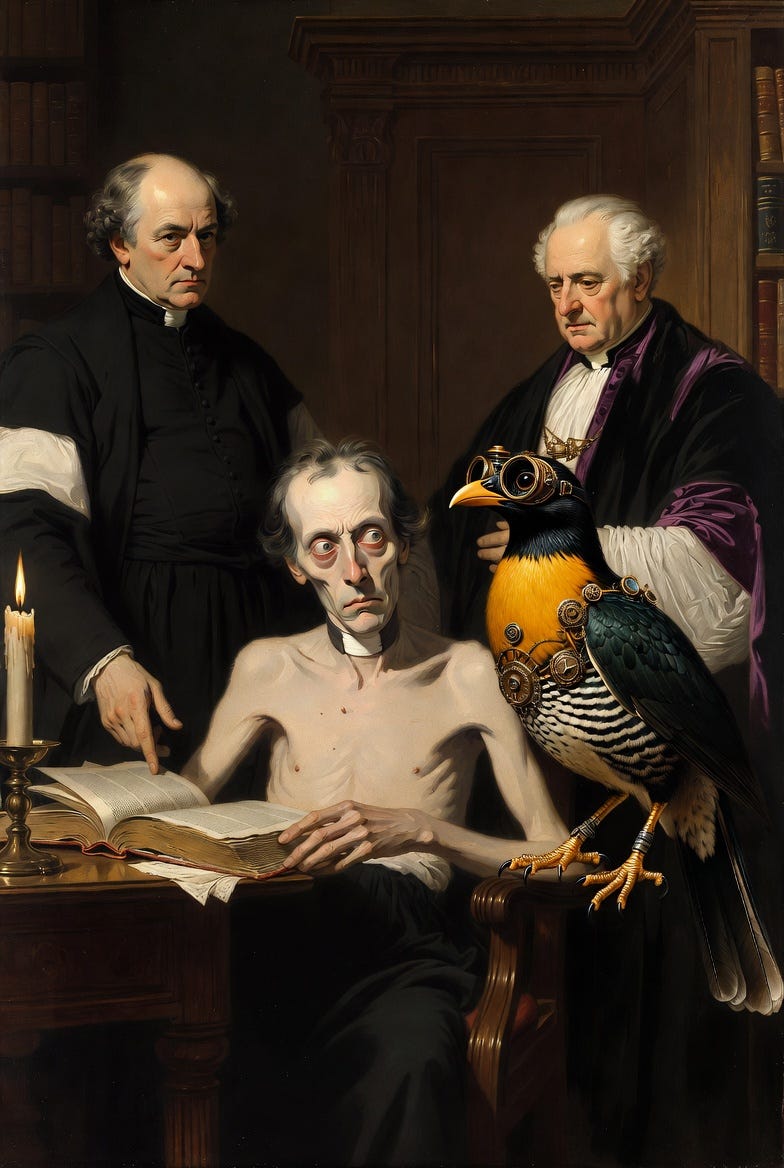
“It seems as if, to a fellow like me, it must always be presumptuous not to despair.” — Richard Hurrell Froude, Remains, vol. i
He was thirty-two when the consumption took him, in the parsonage at Dartington where he had been born, in February of 1836. He left no descendants, no settled doctrine, no book under his own name. What he left was a diary his friends should never have printed, a treatise on a murdered archbishop, and a wound. Two years after his death Newman and Keble published the wound, called it Remains, and frightened the Church of England more thoroughly than anything either of them ever wrote in his own person.
We remember the fright. We have mostly forgotten the man. The standard portrait is the one his editors accidentally painted: Froude the extremist, the Romaniser, the despiser of the Reformers, the brilliant boy who would have swum the Tiber had he lived. There is enough truth in it to have survived a century and a half of repetition. But it is a portrait built on a text his editors had already softened — for even the scandalous Remains was bowdlerised, the harshest lines cut before printing, the recipients of his letters reduced to Greek letters, the proper names blanked. Louise Guiney, working over the wreckage in 1904, confessed the volume was “invalidated, to modern curiosity, by manifold suppressions and omissions.” The real Froude was sharper than the scandal. He was also sadder, and the sadness is the thing the polemic has buried.
This essay is an argument with him. I think he diagnosed his age correctly and prescribed the one cure guaranteed to deepen the disease. But before the argument there is the man, and the man cannot be read out of his positions. He has to be read out of his journal, which is the record of a soul that sought Christ for thirty years and was never once told the thing it needed to hear.
I. The wound
Open the first volume of the Remains and you do not meet a controversialist. You meet a boy keeping accounts against himself. He fasts and records that the fasting made him feel “singular,” and is ashamed of the pride hidden inside the humiliation. He resolves never to argue with his father and breaks the resolution within the week and writes it down. He covets a colt, and a new dining-room window, and a four-oar, and arraigns himself for each. He lays down the governing maxim of the whole enterprise — “everyone ought to be dissatisfied with himself always” — and then keeps the ledger that maxim demands, day after day, with a merciless fidelity that is genuinely terrible to read.
And then, at twenty-three, having read the anguished memoir of a pious man, he writes the sentence that ought to be carved over the entire Oxford Movement:
“It seems as if, to a fellow like me, it must always be presumptuous not to despair.”
Read it slowly. For this man, to not despair would be presumption. Hope is the sin. He has so internalised the demand of a holy God, and so failed to receive the gift of a gracious one, that the only posture he can imagine as honest is despair. That is not piety. That is a soul on a treadmill, running for a sign it is permitted to stop, and finding none.
The astonishing thing is that he could see the treadmill. In the same journal he writes:
“Abstinences and self-mortifications may themselves be a sort of intemperance: a food to my craving after some sign that I am altering.”
He has diagnosed himself. He knows the self-denial is not killing the self but feeding it — that the asceticism is a craving, an appetite for the evidence of his own improvement. He sees it with perfect clarity and he cannot stop, because the faculty that sees it is the same faculty that drives it. And so the prayers turn into self-laceration:
“O my God! I dare no longer offer to Thee my diseased petitions… I have neglected to obey Thy voice, and gone a-whoring after my own inventions. As soon as I was born, I went astray and spake lies.”
This is a man being crushed under the law with no gospel to lift it. He had Keble’s gentle spiritual direction. He had Newman’s incomparable friendship. He had the whole library of the Fathers open before him. And nowhere in any of it did anyone say to him the six words that were the entire point: the work is finished and complete.
II. A Luther without Romans
Here is the thesis, and I cannot improve on the form in which it was given to me: Froude is a Luther without Augustine’s commentary on the Romans.
He had the terror. He had, in full measure, the thing that drove Luther into the monastery and wore out his confessor — the unappeasable conscience, the God whose righteousness is a demand the creature cannot meet, the certainty that to relax is to be damned. Every Protestant who has read the young Luther will recognise the young Froude at once. They are the same wound.
What Froude never had was the deliverance. Luther was broken open by Romans — the just shall live by faith — and behind Luther stood Augustine, the De spiritu et littera, the anti-Pelagian grace that taught him the righteousness of God is the righteousness God gives and not merely the righteousness God requires. The terror found its answer in the doctrine of justification: that the verdict is already spoken, the work already finished, the sinner declared righteous not on the strength of his altering but on the strength of Another’s completed obedience. Tetelestai. It is finished. There is no ledger left to keep, because the account is closed.
Froude went to the same Fathers Luther went to. This is the part that should make a Reformed reader weep rather than gloat. He read them hungrily, the whole patristic shelf — and he came back carrying Cyprian and the apostolic succession, the authority of the Church, the dignity of the priesthood, the theory of a visible body with power to bind and loose. He came back with an ecclesiology. He did not come back with Augustine on grace. He had in his own hands the library that could have healed him, and he read straight past the one shelf that would have. He sought the Church where he might have found the gospel, and the Church he found could give him everything except the one thing his journal was screaming for.
So he did what an honest, dying, untreated soul does. If the self cannot be quieted by grace, it must be subdued by discipline; if discipline is “a sort of intemperance,” then the discipline must be made objective, sacramental, external — imposed by an authority outside the self, because the self has proved it cannot absolve itself. He wrote, with relief, that penance “self-imposed” was “the food of pride,” but penance “imposed by the Church” was something else entirely. Of course he reached for a Church with the power to impose it. A man who cannot say te absolvo to himself will go looking for the office that can say it to him. The whole sacerdotal apparatus he spent his short life defending was, at the root, a search for a confessor with the authority to make the absolution stick.
He needed Calvin in the room — Calvin, who argued from the Fathers as relentlessly as any Tractarian ever did, and who drew from them the opposite conclusion. Calvin would have poured him the wine his Genevan salary supplied by the cask, and told him to stop scourging himself over breakfast: not out of geniality, but because telling a man the truth about his own salvation is the kindest and hardest thing in the world. And Froude would have hated it, because assurance would have disarmed the very faculty that made him brilliant. His genius required his damnation-anxiety to keep running. Grace would have cost him his edge. That is a tragedy of a high order, and it is the human centre of everything else he did.
III. The flaw and the genius were the same organ
Because the harsh self-assessment was not only his affliction. It was his gift. The man who scourged himself over a story badly told at breakfast could scourge a comfortable, self-satisfied, Erastian Church without flinching, because he had already said far worse to himself in the dark. His honesty about the institution was bought with the same coin as his cruelty to his own soul. He could see the rot because he had spent twenty years staring at his own.
And he saw real rot. The England he looked at was a Church that had become, in his brother’s famous phrase, “part of the Constitution,” with the Prayer Book treated as “an Act of Parliament which only folly or disloyalty could quarrel with” — the Royal Arms over the chancel, the squire’s cushioned pew, the Communion table covered in green baize and ignored, dogma dead, the bishops appointed by ministers and grateful for it. Into that somnolence, in 1833, Parliament reached out a hand and suppressed ten Irish bishoprics by civil statute, and Keble climbed the pulpit of St Mary’s and preached “National Apostasy,” and the Movement was born — born, let us be precise, as a protest against the magistrate’s authority over the Church. The Oxford Movement began anti-Erastian. That is the fact the surplice-wars and the incense have obscured.
Froude’s instinct here was sound, and a Reformed man should say so plainly. He hated the spectacle of the State commanding the Church. He admired Becket for asserting the Church’s jurisdiction against the Crown; he admired the Non-Jurors who would not swear; he saw, before almost anyone, that a Church which is a department of the realm has no standing-ground from which to be anything the realm does not already permit it to be. On the disease, he was right.
The early seed is already in the schoolboy. Reading Clarendon at twenty-two, he notes that knowing the Puritans gives him “a better right to hate Milton,” and ends the letter flatly: “I adore King Charles and Bishop Laud!” The Laudian romance is temperament before it is theology — anti-Puritan, anti-Whig, anti-modern, a man in love with a hierarchical past because the levelling present offered his disordered soul no rock to stand on. The doctrine grew out of the man. It always does.
IV. The wrong cure
But the prescription. On the cure he was catastrophically, instructively wrong, and the wrongness has a shape worth naming, because it is the same shape in every age.
He concluded that the fracture was the Reformation itself. The Reformation, he wrote — the line is at Remains i. 433 — was “a limb badly set; it must be broken again in order to be righted.” He recoiled from the standard Protestant histories, Burnet and Strype, the moment he opened them. He turned on Jewel, the great apologist of the Elizabethan settlement, and said his doctrine “ought to be denied under pain of damnation” — and even that was the printed version; Newman and Keble cut a harsher sentence from the same letter before it saw daylight. To attack Jewel is not to grumble about Cranmer’s prose. It is to deny the intellectual foundation of Anglican Protestantism at the root.
Notice what he has done. He felt a fracture — a real one — and he located it in the wrong place. He thought the Reformation broke the Church by tearing it from Rome’s single throne, and that the repair was to recover that throne. He diagnosed a disease of overreach and prescribed a larger concentration of exactly the thing that overreaches. He reached for more centralisation to cure a sickness of centralisation. He fled the throne in the Church and ran straight toward a Church that had made itself a throne.
Why? Partly the soul we have already met: a man who cannot absolve himself wants a supreme office that can. But partly, too, the body. He was dying. He knew it. He had four years, not forty, and a dying man has no patience for the slow re-setting of a limb. “It must be broken again” is not a policy; it is the sentence of a consumptive who cannot afford the gradual healing because he will not live to see it. A man with a long life ahead writes let us patiently re-set the bone over a generation. A man with months writes break it now. The tuberculosis is in the prose. His eschatology of repair is the eschatology of the deathbed, and a single throne is attractive to the dying for the simplest of reasons: it can act now, where a grown and distributed order can only act slowly, and slowly was the one thing he did not have.
V. The two thrones, and the two exits
The error has a structure, and the structure is the whole point.
Erastianism — the State holding the keys — and ultramontane papalism — the Pope holding them — look like opposites. They are the same architecture. Both locate the Church’s earthly authority in a single sovereign locus. And any structure with a single sovereign locus has a single point of failure: it must answer the question what do we do when the locus defects? What happens when the Crown-in-Parliament legislates against the faith — or when the throne of Peter is occupied by a man the faithful cannot follow?
The two architectures fail in opposite ways, and the difference is diagnostic.
When the magistrate defects, the Erastian can walk out. This is the glory of 1843: Thomas Chalmers and four hundred and fifty ministers of the Church of Scotland leaving the Establishment at the Disruption, surrendering manse and stipend and security, rather than submit the Church’s spiritual jurisdiction to the civil courts. Disestablishment is the graceful exit. You lose everything except the thing that mattered, and the thing that mattered — the Church’s own sphere — walks out the door intact in your keeping.
When the Pope defects, there is no walking out, because the entire logic was that the Pope is the visible guarantee of unity. The only move left inside the system is to declare that the man on the throne is not truly on the throne — that the seat is empty. Sedevacantism is not a fringe oddity. It is the strict and necessary terminus of single-throne ecclesiology placed under stress. And it is a catastrophe: it does not produce a Free Church, it produces a dust of warring sects, each with its own true pope or none, precisely because you cannot remove the load-bearing throne without the whole building coming down on your head.
That asymmetry — one architecture failing gracefully, the other catastrophically — is itself evidence about which was soundly built. And it is the final, unanswered irony of Froude’s flight. He ran from a Church that was a department of the State, and he ran toward the one Church that had made itself a State: the tiara a crown, the Patrimony a territory, the pontiffs princes who happened also to ordain. He fled the magistrate in the mitre and embraced a mitre that had swallowed the magistrate. There was never a door at the end of that corridor that was not a throne room.
VI. The answer he would not look for
And here is the part that should grieve us most, because the answer to Froude’s exact question already existed, had been worked out over three centuries, and was being lived out in his own lifetime by precisely the kind of Protestants he held in contempt.
Calvin argued from antiquity. He argued from Augustine above all, from Cyprian, from the first four councils, and the whole posture of the Reply to Sadoleto is that Rome, not Geneva, is the innovator. The Reformers never ceded the Fathers to the papacy; they contested the ownership, and they often held the field. Froude’s move — antiquity entails catholic entails anti-Protestant — was never a logical entailment. It was a historiographical claim that had already been answered, three hundred years before he was born, by men he refused to read for the purpose.
From Calvin’s duplex regimen — man under two governments, spiritual and civil, both ordained of God, neither collapsible into the other — comes the seed. Calvin himself had to fight Geneva’s magistracy for the Church’s control of its own discipline, and the Genevan settlement was the compromise he was forced to litigate, not the radical doctrine he held. Andrew Melville drew the radical doctrine out to its conclusion at Falkland in 1596, telling his king to his face that there were “twa kingdoms” in Scotland, and that in the kingdom of Christ which is the Kirk, James was “not a king, nor a lord, nor a head, but a member.” That is the doctrine of the Crown Rights of the Redeemer — the sole Headship of Christ over His Church — and it turns Erastianism from a governance error into something nearer to lèse-majesté: the magistrate seated in a throne that is already occupied.
So: Oxford in 1833 and Edinburgh in 1843 were asking the identical question. Can the civil power command the Church? And the English high-church answer was recover Rome’s authority, while the Scottish evangelical answer was walk out and stay free. The Tractarians and the Disruption Free Churchmen were the same protest in opposed vestments. The men being shown the door of Canterbury today have more true kin among the Covenanters they would shudder at than among the bench that is dismissing them. Froude did not defeat the Free Church answer to his question. He declined to notice that it existed, because it wore the wrong colours.
VII. The limb badly set
Let me turn his own phrase back on him, because it is the truest thing he ever wrote and he did not know what it described.
A limb badly set must be broken again to be righted. Froude said it of the Reformation. It was never true of the Reformation. It was true of Froude. He was the limb badly set — a soul set in the wrong posture from the start, set in the conviction that it was “presumptuous not to despair,” set without the gospel of assurance that would have let the bone knit straight. And the cruelty of his case is that the cure for a limb set wrong in that way is not to break it again. It is the opposite. It is to be told that the breaking is already done, that Another was broken in your place, that the work is finished and you may stop. He prescribed for the Church the very violence that had been done to his own soul, and what his soul actually needed was not more breaking but the word of peace no one ever spoke to him.
So when we say, with him, that something is broken — and something is broken, he was right about that, he was right earlier than the comfortable men around him who could not afford to see it — we have to be exact about what. It is not Christ. It is not the gospel. It is not the Reformation’s recovery of grace. What is broken is the boundary God set between the spheres: the State reaching into the Church’s jurisdiction, the will reaching past the order of creation, the throne — any throne, Crown or Pope or managerial committee — reaching for a sovereignty that belongs to Christ alone. That is the oldest sin there is, the sin of Babel, the refusal of the creature’s assigned limit. It is hubris breaking the spheres of heaven. And the cure for hubris is never a bigger throne. It is the patient defence of each sphere’s God-given border — and the willingness, when the magistrate crosses it, to walk out of the manse.
VIII. The gap he fell into
There is a cure for the disease Froude actually had, and the divided Church agrees on it. That agreement is rare enough to be worth dwelling on, because it is the quiet centre of this whole sad case.
What ailed him has a name. The Catholic moral tradition called it scrupulosity — the over-tender conscience that cannot accept absolution, that confesses the same sin until the words wear smooth and still finds no rest, that manufactures guilt where there was no act. It is not a height of holiness. It is a sickness of the faculty that is meant to report on real sin, and in the scrupulous that faculty has begun to generate accusations with no referent — fluent, sincere, indistinguishable in dread from the true thing, and anchored to nothing that happened. We have lately built machines that do precisely this: produce well-formed, confident output that corresponds to no fact. A scrupulous conscience hallucinates sins the way such a machine hallucinates citations — and the sufferer cannot tell the false report from the true, because they arrive in the same voice. Froude sat up night after night feeding the day back into that faculty and reading its confabulations as the verdict of God.
And the cure, in both traditions, is the same act. The Catholic directors knew it cold — Ignatius wrote rules for the scrupulous into the Exercises, Francis de Sales built a whole gentle pastoral craft around it, Liguori codified it: the scrupulous penitent is forbidden to re-examine, commanded to accept the absolution as final, told to obey the director’s judgment precisely because his own conscience is the diseased organ and cannot be trusted to absolve. And the Puritan physicians of the soul knew it equally — Baxter, Bolton, Sibbes on the bruised reed that shall not be broken — the same diagnosis of the afflicted conscience, the same refusal to feed it more rigour, the same authoritative reassurance that the matter is closed. Reformed pastor and Counter-Reformation director arrive from opposite premises at one identical instruction: take the pen out of his hand; you may not act on this faculty’s report; the verdict comes from outside you now, and it is mercy. The pastors have always seen this. It is one of the few places the warring confessions converge entirely — and it is exactly the place Froude needed them to.
He fell into the gap between two competencies. Not because his friends were negligent of his soul, but because the toolkit that would have healed him was known and not held by them — and worse, because both of the traditions that held it were closed to him on partisan grounds. He could not reach for the Puritan cure of souls: Baxter and the Calvinist casuists were the enemy his Movement defined itself against. He could not yet reach for the Counter-Reformation directors either: Ignatius and the Jesuits were “Popery,” their manuals untranslated and untrusted, and the Anglo-Catholic craft of direction that would later domesticate them had not yet been built — Pusey would become a confessor of souls, but later, and largely after Froude was in the ground. So the medicine existed, fully compounded, in two cabinets, and both were locked against him by the confessional hatred this essay has otherwise been tracing. The Puritan one was too Protestant for his party; the Jesuit one was too Roman for his Church. He had the key to neither. The same broken sphere that left the Georgian Establishment with no jurisdiction against the magistrate had also let its own cure of souls atrophy under the green baize — a church that has forgotten it has a sphere forgets that souls are its business — and the Roman pastoral craft he romanticised had not yet regrown in English soil. He arrived in the trough between two pharmacopoeias, and died untreated not for want of a cure but for want of permission to take it from the wrong hand.
I will not pretend to administer it now. There is a reason the layman does not go directing souls in deep melancholy: here be dragons, and everyone whose work touches the afflicted mind knows it even when those outside that work cannot see the boundary. The cure of the scrupulous is a craft, and crafts have God-given borders as surely as magistracies do; a man without the formation who tries to direct a hallucinating conscience can become merely one more voice the accusation swallows. So I name where the medicine sat. I do not reach into the cabinet. And I grieve — because the gap Froude fell into has not closed in our day; it has widened. We have psychologised the whole territory, handed the cure of souls to the counsellor, and too often replaced absolution and mercy with a process that manages the symptom and cannot pronounce the verdict, because it does not believe there is one to pronounce. The director who could say the matter is closed, on authority, stop has been a long time leaving the room. That is a thing to weep over, and it is the same wound at a third scale: the sphere that heals souls, broken like the rest.
IX. The fault reopens
This is not antiquarian. The fault Froude felt is, at this moment, reopening along its whole length.
The settlement he protested was always unstable, because it was a contradiction held in suspension from 1559 — the English Church fused two things the gospel never required to be welded together: the recovery of justifying grace, which was sound, and the Royal Supremacy, which was the wound. Every two or three generations the stress concentrates and the weld cracks again: Laud, the ejected Non-Jurors, the Gorham judgment, and now the largest fracture of all. Anglicanism, the communion anchored in an established and magistrate-bound English Church, is splitting — between Canterbury and the Global South realignment of GAFCON, between the see that takes its lead from the settlement and the provinces that will no longer recognise its leadership.
And the geometry of that split is the very argument of this essay made visible in our own moment. The realignment is the Free Church door. To leave Canterbury for the confessing provinces is to do, in catholic vestments, what Chalmers did in 1843: to walk out of a compromised establishment in order to keep a spiritual independence the establishment has breached, and to refound on confession rather than on the magistrate’s settlement. Where a Church was never established at all — as in this country, where Anglicanism has carried the Crown’s shape without the Crown’s law — the fracture is cleaner still: it falls openly between confessions, because there is no establishment to walk out of, only a communion to walk toward or away from. The Froude-sons of the present hour are being offered the two exits we have traced — Newman’s door to a single restored throne, and Melville’s door to a confessing freedom — and most of them cannot see that the second is the sounder one, because they have been trained, as Froude was, to believe that the only alternative to a faithless throne is a truer throne.
So I find myself, at the end of the argument, not triumphing over him but praying for him, and for those still inside the house as it cracks. He sought Christ his whole short life with a passion that shames the comfortable, and no one in his lettered, holy, well-meaning circle ever said to him the thing that would have set the bone straight: the work is finished and complete; you may stop running. It was not that they were silent about grace. It was that the specific medicine for his specific disease lay in two cabinets, and both were locked against him by the partisanship of the hour — too Protestant in the one, too Roman in the other — so that a man surrounded by holy friends died of a curable affliction for want of permission to take the cure from the wrong hand. He died at thirty-two without it. He is the disagreeable uncle of the English Church — the one everyone else found hard to love, the one who said the unsayable true thing and then drew from it exactly the wrong conclusion — and he is, for that reason, far better company than the saints who have been flattened into stained glass. You cannot flatten a man you are still arguing with. And the affection in the argument is itself a kind of honesty: it takes him seriously enough to tell him he was wrong, which is more than his admirers do, and more than the magistrates in their mitres will do for the men they are now managing, gently, with the warm and poisoned word they call kindness.
I am a layman. I cannot say ego te absolvo, and it is not mine to read the absolution. That is the whole burden of this essay turned, at the last, on its author: the word of peace is not a thing any office of mine originates, and to reach for it would be to grasp across exactly the border I have spent these pages defending. No minister and no Church makes that word true. They can only announce it, because it was already spoken — once, finished, at the cross, and again in the verdict that justifies the ungodly without waiting on his altering.
So I will not say to him the thing his circle failed to say. I have no warrant to. But this is true whether or not a confessor was ever found for him, and it was true the whole time he ran: God knew him. And I believe Christ would have said it — would have spoken to that scourged and sleepless soul the one word it never received, the work is finished; you may stop. I believe it. I am not Christ, and it is not mine to pronounce; I can only point past myself to the One whose word it is. The limb did not need breaking. It needed only to be told it was already healed — and the One with the right to tell him had told the world so, long before, in a single finished word.
I finish this on an ordinary Sunday, and find the day’s own office has set the word over it before I could arrange a thing. The first lesson is the blessing the Lord commanded Aaron and his sons to put upon the people:
The Lord bless you and keep you; the Lord make his face to shine upon you, and be gracious to you; the Lord lift up his countenance upon you, and give you peace. So they shall put my name on the Israelites, and I will bless them. — Numbers 6.24–27
This is the priestly blessing: the thing the priesthood was for. The face of God shining, the countenance lifted, peace given — the precise word a man who thought it presumptuous not to despair never once heard from the priests around him. They held the office to speak it over him, and they spoke of his sins instead. Let it be spoken over him now, from the text that commands it, by no authority of mine but God’s own: the light upon his face at last, and the peace.
And the Collect of the day is Cranmer’s — which is a mercy I could never have engineered. For the grace Froude lacked is written down, in the plainest English, in the prayer of the very Reformer he wished denied under pain of damnation:
GOD, the strength of all theym that hope in thee, mercifully accept our prayers; and because the mortal weakness can do nothing without thee, graunt us the helpe of thy grace, that in kepyng of thy commaundementes we may please thee, both in will and dede; through Jesus Christ our lorde. — Thomas Cranmer, 1549
Read it against the journal. The mortal weakness can do nothing without thee. There is the whole of Froude’s failure, named in a single clause — and the cure asked for in the very next breath: not more keeping of the commandments by will and deed, but the help of grace first, so that the keeping might follow from it. He spent his strength trying to please God in will and deed out of a mortal weakness that could do nothing, and all the while the man he wanted damned had already written the prayer that would have set him free. Cranmer holds the grace out. Froude reached past it, for a throne. I will have mercy, and not sacrifice — and here, on this one quiet Sunday, the Reformer returns mercy for contempt, which is the only kind of mercy worth the name.
So I leave him there, under Aaron’s blessing and Cranmer’s collect: kept, and graced, and at peace; the face of the Lord shining upon him, both in will and in deed, through Jesus Christ our Lord. Requiescat.